Saturday, May 18, 2019

Secret Cities in Galilee #1

Secret Cities in the New Testament

King Herod Antipas built this Roman Theater in Sepphoris

Secret City #1 - Sepphoris

Although the vibrant city of Sepphoris laid less than four miles from Nazareth, there is no mention of it in the New Testament. King Herod Antipas, a son of Herod the Great, rebuilt this city after a revolt against Herodian rule. All of this construction activity so close to the sleepy hamlet of Nazareth certainly got the attention of the family of Joseph and his five sons. Craftsmen in stone, metal, and wood were in big demand, and provided a strong middle-class income for Joseph and his family.

King Antipas had a big interest in Jesus and his miracles, and got the chance to meet him after he had fallen into the hands of the governor of Rome. He was disappointed, though, for Jesus declined to show him some divine miracle.


In the years between the rule of Herod Antipas and the end of the Seventh Century, the city reportedly thrived as a center of learning, with a diverse, multiethnic and multi-religious population of some 30,000 Jews, Arabs, and Christians living in relatively peaceful coexistence. 

The Mona Lisa of Galilee: Grandmother of Jesus, or Pagan God?

A strong Christian church tradition identifies Sepphoris as the birthplace of Mary, the mother of Jesus. Mary's mother was Saint Anne, who lived in the city of Sepphoris. The residents of the city did not join the Great Jewish Revolt of AD 66 nor the Bar Kokhba revolt of AD 132-135, which ended with the destruction of the temple. Jewish rabbis and refugees, including the Supreme Council of the Jews (the Sanhedrin) fled to the safety of Sepphoris.

History since the Seventh Century has not been kind to Sepphoris. It was invaded and conquered multiple times, by Arab and Islamic dynasties, Christian crusaders, the Ottoman Empire, the British Mandate, and the new Israeli nation. It rests today as a National Park in Galilee.
Sepphoris in AD 2013 
Next week: another Secret City in Galilee, one which must have been bypassed multiple times by Jesus during his campaign to bring the Kingdom of God to the Jews.

Sunday, May 12, 2019

Grand Opening of the Rolin Bruno Store!


GRAND OPENING! MONDAY 5-13-2019

Rolin Bruno's Book Sales, Publishing, Blog
This is the Sea of Galilee Boat from the First Century. Jesus may have used this boat.
Newsreel Items:

1. John and the Jesus Boat Episode Four is now available online and in print.* This completes the great saga of Jesus' three-and-a-half year ministry in Palestine, accompanied by the teenage apostle John, "the disciple Jesus loved." 
This book, subtitled "A New Hope," covers the first half of the year AD 30, from Jesus' final preaching ministry outside of Galilee through to the great struggle with the murderous High Priest, and Jesus' ascension into heaven. It also reveals what happened to the "Jesus Boat" after the disciples left it behind. * If the eBook is not available Monday, it should upload in just a few days by Amazon.

2. All four of the "Jesus Boat" series books are collected together and available in paperback and eBook at the Rolin Bruno page on Amazon. Go to https://www.amazon.com/-/e/B013NVWUT6 .
Episode One (AD 27, On the Road), covers the time leading up to teen John meeting Jesus, through to Jesus' call of tax collector Matthew Levi, which began the healing of the estranged Alpheus family.
Episode Two (AD 28, Woes and Comfort), continues the story through the storm on the sea and Jesus' command to it: "Peace! Be still!" It ends with the "Dance of Death" by Herod's stepdaughter Salomé.
Episode Three (AD 29, Elijah's Mountain), covers Jesus' and John's visit to Elijah's Mountain, where Jesus was transfigured, as he conferred with Moses and Elijah while Jesus' disciples trembled.

3. The former series titled "John!" is now out of print, although you will still see them on Amazon's Rolin Bruno book page.The new series books are available at lower prices: $8.99 for paperback, and $2.99 for the eBook.
Some of these older books may still be out there in used or new condition, but at higher prices. You may even find one of the hard cover books, originally priced at $30.00. The new series does not include a hard cover option.

4. ANNOUNCING: Rolin Bruno is now a publisher, with his own imprint and publishing outlets. 
He has been publishing through book distributor Ingram, and through the services of Amazon.

5. What? Bruno is blogging again? … Yes, I confess. It's been five months since my last blog post. I can only plead that I've had my nose stuck in a book while I wrote the last two episodes of John and the Jesus Boat. I plan to go back to answering interesting questions on my blog about the Gospel stories, hopefully on a weekly basis.

The Store Is Open! Check It Out Now!

https://www.amazon.com/-/e/B013NVWUT6


Friday, December 7, 2018

Did King Saul Have Memory Loss?


Check This Out:


1 Samuel 16:19, 21 - King Saul sent messengers to Jesse in Bethlehem, saying, "Send me David your son, who is with the sheep." And David came to Saul and entered his service [playing the harp when Saul was depressed].

1 Samuel 17:57-58 - When David came back from killing Goliath he was brought before Saul, still carrying Goliath's head. Saul asked him, "Whose son are you, young man? And David answered, I am the son of your servant Jesse the Bethlehemite."

Did King Saul suffer from memory loss? How could Saul forget David's father, who sent to him "a mighty man of valor, a warrior, prudent in speech, handsome, with whom the Lord abides"? (1 Samuel 16:18) This was the young man who used to play the harp for King Saul when the evil spirit troubled him.

Some Bible commenters have suggested that the verses in First Samuel have gotten mixed up, and are not presented to us in the proper order. But we will tackle this instead by remembering and applying the principles of a real people standing before a real God. Then as a bonus we'll look at the Christology embedded in the story of young David. Who knew?

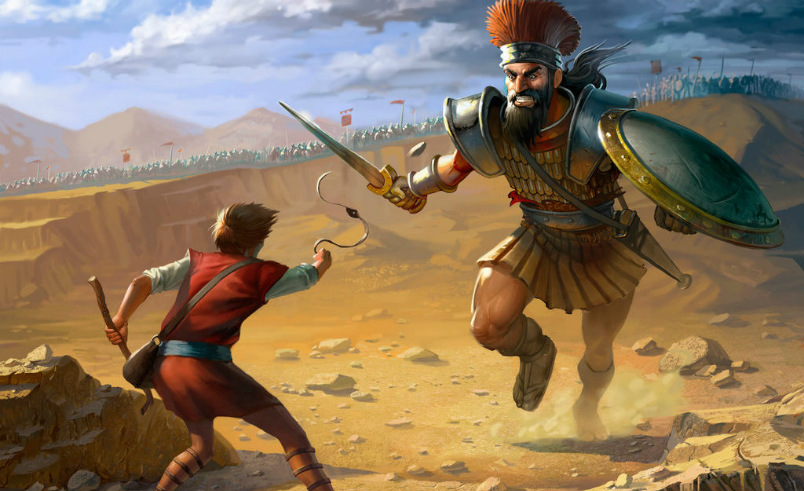
David and Goliath


1 Samuel 17 3 The Philistines stood on the mountain on one side, and Israel on the other, with a valley between them. And out of the Philistine camp came a champion named Goliath of Gath, who was over 9 feet tall. He wore a bronze helmet and a coat of mail, 6 and his shield-bearer went before him. He stood and shouted,  “I defy the ranks of Israel this day! Give me a man, that we may fight each other.” 11 When Saul and all Israel heard these words they were greatly disturbed. 16 For forty days the Philistine came forward and took his stand, morning and evening.

Great fear struck the Israelites, such as they had not known under King Saul. But Saul had no answer for Goliath, except to post a reward for the man who might kill him.

12 Now David was the son of  Jesse, who had eight sons. In the days of Saul, Jesse was advanced in years. 14 David was the youngest, and 15 he went back and forth from Saul to feed his father's sheep at Bethlehem. 13 Jesse's three oldest sons--Eliab the eldest, Abinadab, and Shammah--had followed Saul to the battle. 

Here's David, now a young adult, still relegated to tending his father's sheep--the job of the least and last in the family, a child's job. This although he also had a place in King Saul's court where he used to play the harp to soothe the King.

17 Jesse said to David, “Take this parched grain and these ten loaves, and carry them quickly to your brothers, 18 and also take these ten cheeses to their commander. See if your brothers are well, and bring some token from them.” 20 So David rose early in the morning, left the sheep with a keeper and took the provisions as Jesse had commanded . He came to the encampment as the army was going out to battle, shouting the war cry 21 as Israel and the Philistines drew up for combat. 22 David left the foods with the keeper of the baggage and ran to the ranks to greet his brothers.

David had not been here before. This was a sharp contrast to the peaceful life of a sheep-herder, and he did not know what to expect.

23 As he talked with them, the Philistine of Gath, Goliath by name, came up out of the ranks and spoke the same words as before, and David heard him. 24 All the men of Israel were fearful and fled from him. 25 The men said, “Have you seen this man? Surely he has come up to defy Israel. But the king will give the man who kills him great riches and his daughter in marriage.” 26 David said to the men, “What shall be done for the man who kills Goliath? For who is this uncircumcised Philistine, that he should defy the armies of the living God?”

David's first reaction is to marvel at the insolence of this giant, who had no respect for the God of Israel. This is a disgrace: something must be done about this man.

28 Now Eliab heard him speak to the men and his anger was kindled against David. He said, “Why have you come? And who is watching the sheep in the wilderness? I know your impertinence and the evil of your heart, for you just came down to see the battle.” 29 And David said, “What have I done now? Wasn't it just a word?” 30 And he turned away from Eliab to speak to the people, who answered him again as before.

No respect. David gets no respect at all from his brothers. He should go back to tending daddy's sheep.

31 When the words David spoke were heard by the people, they repeated them before Saul, who sent for him. 32 David said to Saul, “Let no man's heart fail because of this Philistine. Your servant will go and fight him.” 33 And Saul said to David, “You aren't able to go against this Philistine, for you are but a youth, and he's been a man of war all his life.” 34 But David said to Saul, “Your servant used to keep sheep for his father. And when a lion or a bear came and took a lamb from the flock, 35 I went after him and struck him and saved it out of his mouth. And if he rose against me, I caught him by his beard and struck and killed him. 36 Your servant has struck down both lions and bears, and this uncircumcised Philistine shall be like one of them, for he has defied the armies of the living God. 37 The Lord who saved me from the lion and the bear will protect me from this Philistine.” So Saul said to David, “Go, and the Lord be with you!”

Notice that David does not attribute his great prowess to himself, but to the favor of the almighty God of Israel.

38 Then Saul clothed David with his armor. He put a helmet of bronze on him and clothed him with a coat of mail, 39 and David strapped his sword over Saul's armor. But he tried in vain to use them. David said to Saul, “I cannot go with these, for I have not tested them.” So David took them off. 40 Instead he took his staff in his hand and chose five smooth stones from the brook and put them in his shepherd's pouch. His sling was in his hand, and he approached the Philistine.

Here we see confirmed the fact that David had no training in warfare or hand-to-hand combat. He goes instead to the weapons he had available to him as a boy, and trusted in God for his safety.

41 The Philistine moved forward and came near to David, with his shield-bearer in front of him. 42 When he saw David up close he scorned him, as if he was just a rosy handsome youth. 43 He said to David, “Am I a dog, that you come to me with sticks?” And the Philistine cursed David by his own gods. 44 He said to David, “Come to me, and I will give your flesh to the birds of the air and the beasts of the field.”

Goliath is un-cowed and confident in dispatching this puny youth. But David also was undaunted, and replied in kind.

45 David said to Goliath, “You come against me with a sword and a spear and a javelin, but I come to you in the name of the Lord of hosts, the God of the armies of Israel, whom you have defied. 46 This day the Lord will deliver you into my hand, and I will strike you down and cut off your head. And I will give the dead bodies of the host of the Philistines this day to the birds of the air and to the wild beasts of the earth, that all the earth may know that there is a God in Israel, 47 and that all this assembly may know that the Lord saves not with sword and spear. For the battle is the Lord's, and he will give you into our hand.”

David knew how to respond to Goliath's threats, and what a calamity it would be to the Philistines if their champion was struck down.

48 When the Philistine drew near, David ran forward to meet him. 49 He reached in his bag, took out a stone and slung it, and struck Goliath on his forehead. The stone sank into his temple, and he fell on his face to the ground. 50 Thus David prevailed over the Philistine with a sling and a stone, and struck the Philistine without a sword in his hand.

Now the tables are turned. The Philistines watching are frozen in astonishment.

 51 Then David ran and stood over Goliath and drew his sword out of its sheath and killed him and cut off his head with it. When the Philistines saw that their champion was dead, they fled in disarray. 52 And the men of Israel and Judah rose with a shout and pursued the Philistines, so that the wounded Philistines fell along the way as far as Gath. 53 And the people of Israel came back from chasing the Philistines, and plundered their camp. 54 David took the head of the Philistine and brought it to Jerusalem, but he put Goliath's armor in his own tent.

None was more astonished than King Saul. Here a people frozen in fear had been saved from an unexpected corner, by a mere youth. 

55 When Saul saw David go out against the Philistine, he said to Abner, the commander of the army, “Abner, whose son is this youth?” And Abner said, “As your soul lives, O king, I do not know.” 56 And the king said, “Inquire whose son the boy is.” 57 And as soon as David returned from striking down the Philistine, Abner brought him before Saul with the head of the Philistine in his hand. 58 And Saul said to him, “Whose son are you, young man?” And David answered, “I am the son of your servant Jesse the Bethlehemite.” (Abridged from the English Standard Version (ESV)) 

Here is the place where we must apply the principles of a real people and a real God. Saul was not just some icon reining over Israel and playing out his fate from a gilded throne, surrounded by mighty men of valor well-trained in the martial arts. 

Saul was limited like all of us, and couldn't conceive that the salvation of his nation should come from a sleepy hamlet in the countryside. Saul knew very well where David came from, but in Saul's mind there had to be something more, something in his line that marked him out for future fame. Where did this David really come from, that destined him to be the killer of Goliath? "Whose son are you, young man?"

We can compare this to the twelve apostles, who were saved from a mighty storm by a few words from Jesus: "Peace! Be still!" They thought they knew Jesus,  but they didn't know him as someone who could command the forces of nature. Who was this Jesus, anyway? 

For Saul and for the Apostles, they had failed to account for a real God, who created the world, and cared for his people, and had unlimited power to redeem his beloved.

Christology: a "type" of Christ.


You may have seen this used before: an event or person in the Old Testament that is manifested as a type of things to come, that sets a pattern. Both David and Jesus began from very humble circumstances. Their first appearance was almost hidden: the anointing of the child David and the manger scene of the infant Jesus, two events that slid away into the realm of history long before they became consequential to Israel and the world. 

Both David and Jesus were dis-respected by their brothers, who did not believe that great things would become of them. For both of them, their power, or the power of God, worked through them to bring things to pass that seemed impossible. Both of them fed their brothers and Israel's throng. Both of them had to defend themselves from allegations of evil intentions. And both of them faced their challenges with great courage.

There are other similarities, but from these few we can see that David was a type of Christ who came to save the people of Israel. We see a real God. working his way with real people to show his love to the people of God.

Monday, November 5, 2018

Simon Son of John, Do You Love Me?

PETER'S GREAT TEST


Jesus Teaches for Forty Days


Jesus has been crucified, yet he lives on! He appears to some of his disciples, such as two men on the road to Emmaus, and ten of his apostles gathered in a secret room in Jerusalem. A week later, he appears to them again, this time including "doubting" Thomas, who falls down at his feet saying, "My Lord and my God!"

At Jesus' direction (Mark 14:28), the apostles go north to Galilee and wait for him there. Simon Peter and six more apostles were together one evening at the side of the Sea of Galilee where Peter and Andrew's well-worn fishing boat was dragged up on the shore and unused.

Then Peter said, "I'm going fishing."

The other apostles said, "We're going with you."

They fished all night, but like many another night caught nothing in their nets. The sun was coming up, so it was time to give up and pull the boat back up out of the water. When they were still a hundred yards from shore, there was a man standing there who called out, "Children, you don't have any fish, do you?"

"No," they answered.

The man said, "Cast the net on the right-hand side of the boat and you will find some."

Doubtfully, they did so, and they caught more fish than the net could safely hold. By this time they were suspicious, but it was John son of Zebedee who said to Peter, "It's the Lord!"

Peter immediately threw himself into the water to get to Jesus, But the rest of the apostles used the small shore-boat to tow the net full of fish into shore. There Jesus had built a cooking fire and said, "Bring some of the fish you've caught. Come and  have breakfast.

Simon son of John


When they had finished eating, Jesus said to Simon Peter, "Simon son of John, do you love me more than these?"

Simon son of John? What happened to the new name Jesus had given him, "Peter." Why is Jesus addressing him by his patronym, the name of his father? It has been three years since Jesus took his walk down that beach , and called out to the four fishermen, "Follow Me!"

Jesus had made  it very clear that their old lives of hauling in fish were over, and they were to lead new lives as "fishers of men." Was Simon Peter thinking of returning to his old life? His father John had helped establish a prosperous wholesale fishing cooperative that fed his family well. When his father no longer fished, Simon took over his father's share in the co-op, partnering with old hand Zebedee and his two sons. Before Jesus came along, that was their destiny, to continue their families' traditions on the Sea of Galilee.

Just to make it sink in, Jesus repeated his question twice more, and emphasizing Simon Peter's new career: "Tend my lambs. Shepherd my sheep. Tend my sheep."

When Simon Peter said, "You know that I love you," he knew that he was re-affirming the commandment of Jesus: "If you love  me, keep my commandments."

Me, Myself, and I


Do you and I do the same thing? Does it sometimes seem easier to go back to our usual ways instead of serving Jesus? I know I have done it. But Jesus is always there, saying, "My child, do you love me?"


Saturday, October 20, 2018

Jesus in His Father, 12 Years Old

How can somebody be "in his father?"


Jesus was having a good time in the temple, amazing the rabbi's and teachers with his advanced understanding of the Scriptures. He would ask questions that seemed beyond that which would be expected for a twelve-year-old. And when the learned professors would ask him a question they were even more astonished by his answers.

In the meantime, his parents were on their way back home, blithely unaware that Jesus was not among the caravan on its way to Nazareth. At the end of a full day's journey, his parents began searching for him among their relatives and acquaintances, but he was  nowhere to be found. The next morning, they had to return to Jerusalem to scour the city for him.

They finally found him in the temple, of all places, dazzling teachers and rabbi's. By this time his mother Mary was perturbed, and said to him, "Son, why have you treated us this way? Look, your father and I have been anxiously searching for you!" (Luke 2:48)

Then Jesus replied in a peculiar way. He responded,

"Why were you looking for me? Didn't you know I had to be in my Father?"

"In my Father?" What does that mean?
Many translators struggled with that, unwilling to leave Jesus' answer as found in the original Greek. They attempted to 'fix' Jesus' answer by adding more words so that it made more sense to them.

Some translators rendered it "Didn't you know I had to be in my Father's house?"
Or worse, others put it "Didn't you know I hade to be about my Father's business?"
(The better translations put these added words in italics to mark them as not present in the original.)

The better course would have been use of the maxim, "Let Scripture define Scripture." It's a short hop to the book of John, where we find Jesus telling us what "in my Father" means, at John14:20.

"In that day you will know that I am in my Father, and you in me, and I in you"

This bears closer examination. Here is John 14:20-21a, saying "In that day you will know that I am in my Father, and you in me, and I in you. Whoever has my commandments and keeps them, he it is who loves me. And he who loves me will be loved by my Father, and I will love him and show myself to him."

When Jesus is in the will of the Father, he is in his Father. When you and I keep Jesus' commands, we are in Jesus. When we are in Jesus, we are loving him. And we who loves Jesus will love the Father, and Jesus will love and reveal himself to us.

So what went wrong?


Jesus knew where he had to be, but this twelve-year-old jumped the gun. There is a time for everything, and the time for Jesus to begin his ministry had not yet begun. Instead, it was time for Jesus to finish growing up, and gain more wisdom (Luke 2:52).